

Spinal Decompression in Jersey City: How It Works & Who It Helps
Decompression therapy is a potential treatment option for discomfort in the knees, hips, spine, and other joints. Pain can be reduced with this therapy without requiring surgery. Our board-certified Dr. David Sylvester DC offers spinal decompression therapy to relieve your pain by reducing the pressure within the discs. For more information, contact us or book an appointment online. We serve patients from Jersey City NJ and surrounding areas.
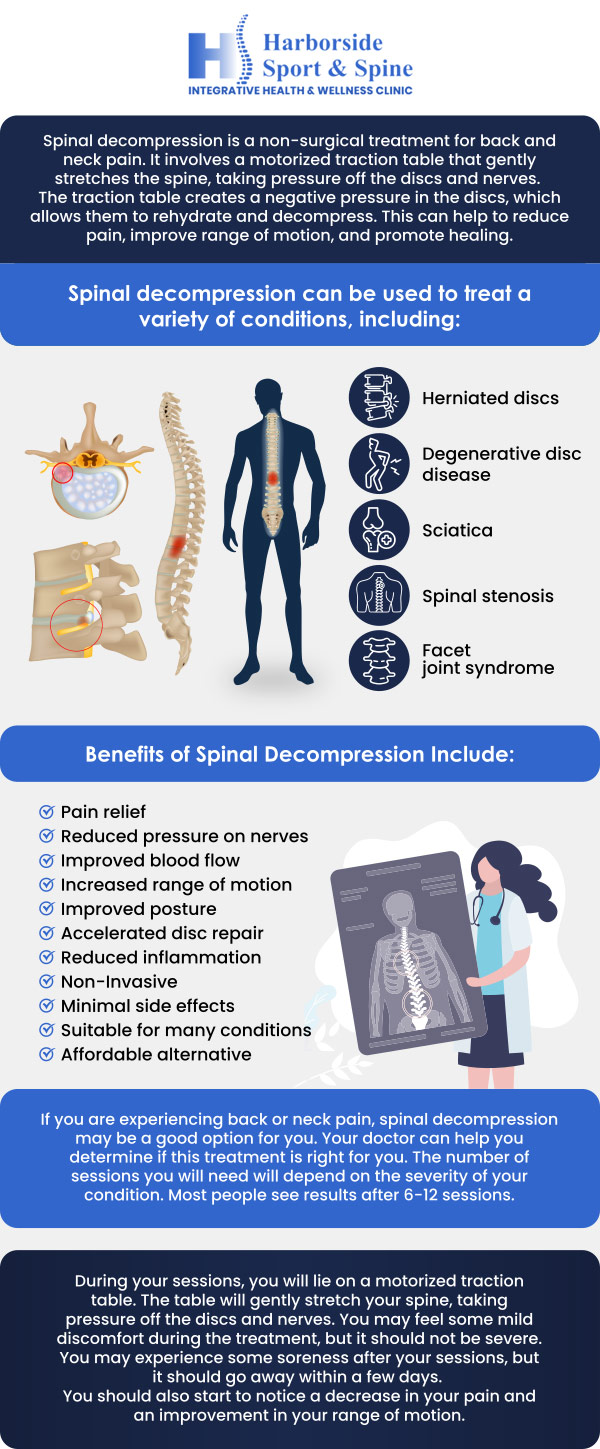
Table of Contents:
How quickly does spinal decompression work for lower back pain?
Who is a good candidate for spinal decompression for lower back pain?
What does a compressed spine feel like?
What is the difference between traction and spinal decompression?
How can Dr. David Sylvester at Harborside Sport & Spine determine if spinal decompression is right for you?
Spinal decompression therapy is a noninvasive procedure designed to reduce pressure on the spinal discs, which can improve symptoms in patients with disc-related back pain. The process is performed in a chiropractor’s office and involves the patient lying in a face-up position on a table. To perform spinal decompression, the chiropractor begins by gently stretching the patient’s spine and back, which creates a negative space in the compressed vertebrae, allowing fresh oxygen and nutrient-rich blood into the area.
One of the most common questions patients ask is regarding the timeline of recovery. In many cases of mild to moderate back pain, patients experience some immediate relief from their symptoms after just one session. However, spinal decompression is a cumulative therapy; it provides compound benefits with each treatment.
In more severe cases, it can take multiple sessions to achieve the greatest benefit, depending on the patient’s condition, lifestyle, and overall health. The speed at which someone finds relief will depend on a number of factors, including:
The type of pain: Is it muscular, nerve-based, or structural?
The severity of pain: How long has the issue been present?
Their overall health: Hydration levels, weight, and age play a role.
If any underlying conditions are present: Conditions like arthritis or stenosis can influence the timeline.
The number of treatment sessions: Adherence to the schedule is key.
In most cases, patients require a series of visits in order to achieve the best outcomes. The exact number of sessions is dependent upon the cause of pain and its severity. Because the goal is to physically change the physiology of the disc, “quick fixes” are rare. For treating chronic pain, patients may be prescribed 20 to 28 treatments over a five to seven-week period. Each session typically lasts around 15 to 45 minutes, during which most patients are so relaxed they may even fall asleep.
Not every type of back pain is the same, but decompression is incredibly versatile. People who are experiencing certain symptoms of lower back pain may be considered a good candidate for spinal decompression therapy, including the following:
Lower back pain radiating down the hips: Often a sign of L-spine compression.
Pain that radiates down one leg: A classic symptom of nerve root impingement.
Significant pain that negatively impacts the quality of life: When pain prevents sleep or work.
Pain does not respond to other treatments: When massage or standard adjustments haven’t worked.
Difficulty walking or standing: Pressure that increases when upright.
Lower back pain is only relieved by bending: This suggests that opening the spinal spacing manually provides relief.
Furthermore, patients dealing with these diagnosed conditions may also be good candidates for spinal decompression:
Chronic back, neck, or lower back pain: Long-term issues that have not resolved.
Sciatica: Shooting pain caused by compression of the sciatic nerve.
Bulging discs or degenerative disc disease: Wear and tear that thins the spinal discs.
Posterior facet syndrome: Inflammation in the joints connecting the vertebrae.
Injured or diseased spinal nerve roots: Radiculopathy caused by compression.
Recognizing the symptoms early is crucial for effective treatment. Compression doesn’t always feel like a “backache.” Common symptoms of the compressed spine include:
Balance issues: Feeling unsteady on your feet.
Pain and stiffness in the neck: Specifically difficulty turning the head.
Pain and stiffness in upper/lower back: A feeling of tightness that won’t go away.
Burning pain that radiates to other areas of the body: Including the arms, buttocks, or legs.
Numbness, weakness, cramping in hands, arms, legs: Pins-and-needles sensations.
Loss of feeling in the feet: A dangerous sign of severe nerve compression.
Hand coordination problems: Dropping objects or difficulty buttoning shirts.
Weakness of one foot or both feet: Often called “foot drop.”
This is a frequent point of confusion. Spinal decompression and traction are similar in concept, which often leads to patients assuming they are the same. However, there are important distinctions that set these two therapies apart, including the way they are performed and their effectiveness.
Spinal traction is a simpler, older form of therapy. It relieves pressure on the spine and can be performed manually or mechanically. Manual traction involves chiropractors using their hands to induce a state of traction, then using manual force to widen the spaces between the vertebrae. While helpful for temporary stretching, general traction can sometimes trigger a “muscle guarding” response, where the body’s muscles tighten to protect the spine, potentially counteracting the stretch.
Spinal decompression, on the other hand, is a highly advanced, non-surgical therapy. It is not manual, but mechanical and computer-controlled. It involves the patient lying on a table with special tools that can stretch the spine, including ropes, slings, and pulleys connected to a computerized motor. The computer monitors the patient’s resistance and adjusts the pull force gently and subtly. This “tricks” the body into relaxing, bypassing the muscle guarding reflex. This allows the treatment to target one or several pinched nerves of the spinal column specifically and effectively.
Both therapies are types of spinal traction procedures, and both are highly effective at relieving back pain and nerve pressure, but one treatment may work better for some patients than the other. If you have lower back pain and have not found relief from other methods, come to Harborside Sport & Spine for spinal decompression therapy.
Spinal decompression is a non-surgical therapy designed to relieve pressure on spinal discs, often used to treat herniated discs, sciatica, and chronic lower back or neck pain. At Harborside Sport & Spine, Dr. David Sylvester DC, evaluates your condition thoroughly before recommending spinal decompression. One essential question to ask is how your diagnosis and symptoms align with this treatment method. Dr. Sylvester uses advanced diagnostic tools and a personalized consultation to assess whether you’re an ideal candidate.
At Harborside Sport & Spine, spinal decompression is often part of a broader care plan that includes chiropractic adjustments, rehabilitation exercises, and lifestyle guidance. The goal is not just short-term relief but long-term spinal health and mobility. If you’re struggling with disc-related pain or nerve compression, Dr. Sylvester can help determine if this gentle, effective therapy can bring you lasting relief without surgery or medication. Contact us today or book an appointment with our spinal decompression therapy specialist, or visit our clinic conveniently. We serve patients from Jersey City NJ, Hoboken NJ, Weehawken NJ, West New York NJ, Guttenberg NJ, Secaucus NJ, Harrison NJ, Kearny NJ, Newark NJ, Belleville NJ, Lyndhurst NJ, East Orange NJ and Elizabeth NJ.
Check Out Our 5 Star Reviews

Chiropractic and Physical Therapy Services
▸ Chiropractic
▸ Physical Therapy
▸ Massage Therapy
▸ Acupuncture
▸ Spinal Decompression
▸ Prenatal Chiropractor
▸ Ear Infections
▸ Foot Pain
▸ Headaches
▸ Scoliosis
▸ Slipped Disc
▸ Sprained Ankles
▸ Stress
▸ Frozen Shoulder
▸ Osteoporosis
▸ Shoulder Pain





 Send Text
 How May I Help You?